Transcript
Announcer:
You’re listening to DermConsult on ReachMD. This episode is sponsored by LEO Pharma. And now, here’s your host, Dr. Shelina Ramnarine.
Dr. Ramnarine:
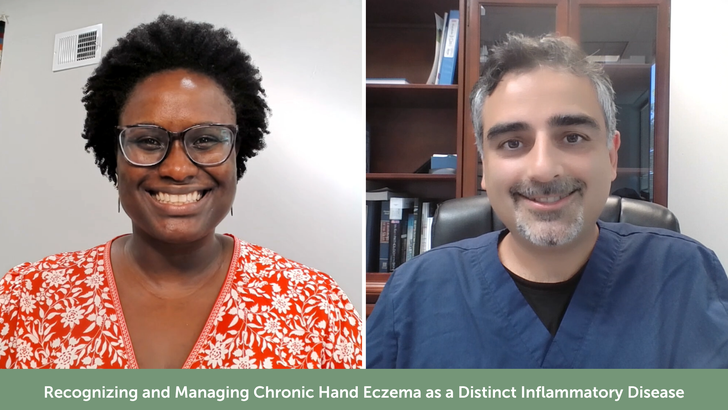
This is DermConsult on ReachMD, and I'm Dr. Shelina Ramnarine. Joining me to discuss the importance of recognizing and managing chronic hand eczema as a distinct inflammatory disease is Dr. Firas George Hougeir. He's a board-certified dermatologist and Mohs micrographic surgeon, as well as a clinical trialist at Southeast Dermatology Specialists in Georgia.
Dr. Hougeir, welcome to the program.
Dr. Hougeir:
Thank you for having me.
Dr. Ramnarine:
Well, let's dive right in, Dr. Hougeir. Hand eczema is something dermatologists encounter regularly in practice, but chronic hand eczema is increasingly being recognized as its own distinct clinical entity. So what defines chronic hand eczema, and how do chronicity thresholds and phenotypic patterns factor into that classification?
Dr. Hougeir:
So chronic hand eczema is hand dermatitis that lasts over three months or recurs more than twice in one year with complete clearance in between. It's multifactorial. It's affected by genetics as well as exposure. And it's distinguished from other forms of hand eczema by that chronicity that you discussed and by the fact that it has multiple subtypes that often coexist.
We have multiple subtypes. There is allergic contact, and there's irritant contact hand dermatitis. There's also protein contact hand dermatitis and atopic hand dermatitis, or hand eczema, by the way, for all of these. And depending on which one, actually, the inflammatory pathway and the inflammatory axis can be different. For example, looking at irritant contact dermatitis, that's thought of to be mostly a Th1 to Th17 axis. In allergic contact dermatitis, the inflammatory pathway depends really on what the allergen is. If it's nickel dermatitis, that could be something else. If it's another allergen, this could be another inflammatory pathway. All that to say how complex this disease is and how important it is for us to treat the disease broadly until we have a better understanding of what's causing it.
Now, we also classify them clinically differently, right? Where there is vesicular hand eczema, hyperkeratotic hand eczema, and nummular hand eczema. There's pulpitis, which is at the finger edges, inflammation. Many descriptions to a process that is more than likely multiple disease processes that we are lumping in one because we need to. And that influences our guidelines about how to identify and also how to treat.
So when you look at chronic hand eczema, again, to summarize, the chronicity of it is very important. It is hand dermatitis that lasts three months or more, or the repetitive nature of flares within one year, which has to be more than two flares in one year with clearance in between. That's what defines chronic hand dermatitis.
Dr. Ramnarine:
Beyond what's visible on the skin, what do you hear from adult patients about how chronic hand eczema affects their day-to-day lives, both at home and at work? And how does long-term skin barrier disruption play a role there?
Dr. Hougeir:
So when you look at hand eczema, it depends on severity, but in moderate-to-severe hand eczema, the burden is quite high on the patient's quality of life. There are signs and symptoms that are prominent. Pruritus, or itch, seems to be the most prominent one, followed by erythema, scaling, and pain, which could be burning or stinging as well.
When you think about this being present chronically for over three months or coming back multiple times during the year, you can imagine the impact it has on the quality of life of these patients, whether at work, at school for the adolescents, or in their daily activities.
Dr. Ramnarine:
You mentioned adolescent patients. What are some of the unique challenges they face?
Dr. Hougeir:
So here in the United States, where they play a lot of sports, we have kids who play baseball, and if they have chronic hand eczema, that is not something that we should take lightly. It does affect them tremendously when going to school and writing when you have a lot of pain with your right hand because you have pulpitis or your palm is affected by severe chronic hand eczema. This affects the child and adolescent, not only in school but also with their social circles, like shaking hands. Anything that affects adults, when you think about it, in an adolescent can be even more important in their quality of life.
Dr. Ramnarine:
Now, once you've established a diagnosis of chronic hand eczema, where do topical corticosteroids fit into your treatment approach, and what guides your decision-making around their use?
Dr. Hougeir:
I think treating hand eczema and chronic hand eczema in particular quickly, as soon as we identify it, and treating it hard is very important. Topical steroids are still the first line and a mainstay of treatment, whether we like it or not. The insurance will make us do that anyway.
But they do come with caveats. We can treat with strong steroids, with super potent steroids like clobetasol, but we have to treat within certain guidelines. Anything over 30 days is no longer a short-term course. I do not like to have anybody at more than 30 days in continuous treatment. As a matter of fact, the indication for something like clobetasol is two weeks, and anything more than two weeks is now off label.
We know that topical steroids can be very helpful, but we also know that they come with potential side effects like atrophy because of the inhibition of stratum corneum repair by high potency steroids. We can also have corticosteroid dermatitis that could happen with them, so we need to be aware of these treatments.
So if we try these and they don't work, then we should be able to move on to non-steroidals, whether they are TCIs, like calcineurin inhibitors, but also our newer treatments such as JAK inhibitors—delgocitinib, for example, is approved now, and it’s the only topical approved for chronic hand eczema specifically—as well as other treatments that we have available to us.
Dr. Ramnarine:
For those just joining us, this is DermConsult on ReachMD. I'm Dr. Shelina Ramnarine, and I'm speaking with Dr. Firas George Hougeir about how we can better recognize and manage chronic hand eczema.
As our understanding of chronic hand eczema's underlying biology has evolved, it's driven a growing body of evidence and guidance around how to manage it. So Dr. Hougeir, how has that changed the conversation around the disease, and can you walk us through some of the recent findings we should be aware of?
Dr. Hougeir:
The identification of chronic hand eczema in the United States as a disease itself is already a great improvement. This has been studied and discussed in other areas of the world for now quite a while. In the United States, it's not really disease that we had been discussing too much until recently.
It is a condition that has multiple subtypes. So depending on what we believe it is, and one of the first things we do is try to find a trigger and alleviate the trigger as well as treat the chronic hand eczema itself. Now, what makes it complicated, again, is that multiple subtypes could be there at the same time. We can in fact stop the trigger and still have to deal with the chronic hand eczema. But we have the discussion, and we have a lot of findings that one, show the amount of impact that that this has on our patients, and then two, come to a consensus somewhat on to how to proceed in treating these patients.
Dr. Ramnarine:
Given those findings, along with everything else we've learned about chronic hand eczema, how do you approach managing these patients, particularly those with moderate disease? And what does a comprehensive treatment plan actually look like in practice?
Dr. Hougeir:
So that is a great question. As we just discussed, I think that the first thing is to find if there is a trigger we can identify or something that is playing a role in chronic hand eczema we can identify and try to avoid this. Now, this can take a long time to do, right? So finding the trigger, finding the potential cause, if we ever can find it, can take a long time. It can take a multi-specialty approach.
In the meantime, though, we still have to treat our chronic hand eczema. So emollients are always something that is very helpful. Topical treatment, as we discussed before, immediately, initially if we need to with topical steroids, high potency if we need to, and then move on relatively quickly if they're not working to other treatment modalities are also important. So we treat while we try to identify the cause. We do not get the cause first and then the treatment afterwards.
While we're doing this, our patient is still suffering. Thankfully, we do now have really good results, and we have data where we have treatments that can cover the multiple etiologies, the multiple subtypes, at the same time, because depending on which subtype we have, the inflammatory pathway that could be involved is different. And we now have treatments, medications, and topicals that in fact address broad inflammatory pathways—multiple pathways at the same time. The newer JAK inhibitors—with delgocitinib, because it is approved for chronic hand eczema, one of the things that makes it a good treatment for chronic hand eczema is the fact that being a pan-JAK inhibitor makes it able to address multiple pathways at the same time. Steroids can do also the same thing or similar things, and if they work, that's fine as well. But always know that we may be dealing with multiple etiologies at the same time, and the treatment should address multiple etiologies at the same time, unless, of course, we're lucky and this is a very specific subtype where we know what the cause is. And if we catch it early enough, avoiding that trigger and stopping that trigger can in fact help us tremendously as well.
Dr. Ramnarine:
And finally, Dr. Hougeir, chronic hand eczema is by definition a persistent condition, and its management clearly goes well beyond a single treatment decision. So how do you think about long-term disease management for these patients and what does success ultimately look like?
Dr. Hougeir:
Like in many disease processes, I feel that we treat our patients successfully when we make their disease—in this case, chronic hand eczema—not a big hindrance to their daily life, where they don't think about it every day or don't think about it much at all. And the best way to do so—there's a goal in my treating my chronic hand eczema patients—is, one, to clear them, and then to keep them clear where they don't have as many flares, but also, if they have flares, to give them the tools they can start addressing them immediately without having to worry and wonder when the next time they can get in with me once they call my office is. So having treatments that are safe and having treatments that can be used on demand once we clear them is important as well.
Dr. Ramnarine:
With those final insights in mind, I'd like to thank my guest, Dr. Firas George Hougeir, for joining me to share his perspective on chronic hand eczema recognition and management. Dr. Hougeir, it was great having you on the program.
Dr. Hougeir:
Thank you so much for having me. It was a pleasure.
Announcer:
This episode of DermConsult was sponsored by LEO Pharma. To access this and other episodes in our series, visit DermConsult on ReachMD.com, where you can Be Part of the Knowledge. Thanks for listening!